Friday, November 15, 2013


Thursday, November 14, 2013
X-Solicits for February 2014

|
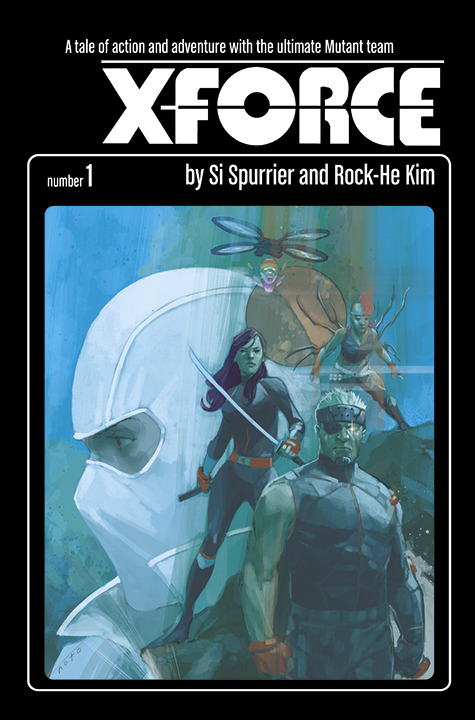
X-Force #1
Writer: Si Spurrier
Art & Cover by: Rock-He Kim
Variant Cover by: Phil Noto
Sketch Variant by: Phil Noto
Animal Variant by: Cook
Almost every
sovereign state in the Marvel Universe makes use of sanctioned superhumans to
protect national interests and pursue a covert agenda. The United States has
the Secret Avengers. The United Kingdom has MI13. And mutantkind has X-FORCE.
In this dirty, secret, no-holds-barred, deadly game of superhuman black ops,
veteran X-Man Cable and his team will spy, torture, and kill to ensure that
the mutant race not only has a place in the world…but also a stake in it.
|
|
|
|
 |
X-Men #10.NOW & 11
Writer: Brian Wood
Art by: Kris Anka
Covers by: Terry Dodson
Issue #10.NOW - Variant Cover by:
John Cassaday
Issue #10.NOW - Sketch Variant by:
John Cassaday
Issue #10.NOW - Animal Variant by:
David Lopez
Issue #11 - Variant Cover by:
TBA
AN ALL-NEW
SISTERHOOD! The X-Men have taken down super villains, aliens and their own
future selves…but never all at the same time! Lady Deathstrike has put
together an all new Sisterhood, her own illuminati to take down the X-Men and
take over the world. Recruiting the likes of Typhoid Mary and Enchantress,
her cabal go on a global hunt for the most powerful of them all…an enemy who
holds the X-Men responsible for her almost-destruction. Meanwhile, M settles
in and Rachel comes to terms with her relationship with Sublime.
|
|
|
|
 |
A+X #17
Writer: Gerry Duggan & Sean Ryan
Art by: David Yardin & Goran Parlov
Cover by: Goran Parlov
• SPIDER-MAN +
PSYLOCKE= a heart-breaking story from their past!
• Part 5 of the
CAPTAIN AMERICA + CYCLOPS story by Gerry Duggan (DEADPOOL) and David Yardin
(X-FACTOR)
|
Tuesday, November 12, 2013


X-Force Goes On The Offensive With New #1 By Spurrier & Kim

Newsarama spoke with Simon Spurrier just as X-Force was announced, digging into this new series springing out of the end of Cable & The X-Force and Uncanny X-Force, his plans for the book, and how the team fits in the modern Marvel landscape.
Newsarama: Simon, what can you tell us about this new X-Force series?
Simon Spurrier: We-ell, let’s see. Starting with the practicalities: it’s starting in February, in the wake of the explosive collision-course crossover between the two current X-Force titles (Uncanny and Cable And The) titles, collectively called “Vendetta.” Which is going to be uh-maaa-zing.
The new book features art by the astonishing Korean artist Rock-He Kim (100% talented, 100% best-sounding-name-ever) and wordmakings by yours truly. It’s a reboot in the sense that we’ll be launching with a whole new setup, new agenda, etc, but it’ll propagate some of the preoccupations, characters and the overall spirit of what’s always made an X-Force book an X-Force book. To whit: an uncompromising attitude, no shying-away from difficult to swallow imagery and themes, and a really involved look at a fascinating character ensemble.
My aim is to present something thrilling and smart, packed full of ideas and awesome character moments, with some important subtext for those who care to see it and oh-so-very-much explodo for those who don’t.
Nrama: Since 2008, X-Force has been a kind of black-ops mutant squad; is that what this new iteration is as well, and if so, who or what are they after here?
Spurrier: In one sense that’s exactly what they’re going to be here. We decided quite consciously to return to the trope which made, say, Rick Remender’s run on Uncanny X-Force such a successful brand: a superhero team, with a questionable sanction, operating with a very clandestine paramilitary bent. To me part of the reason the X-books work so well is that everyone on the planet has experienced some form of exclusion at one time or another, so all those themes – equality, prejudice, acceptance – are very relatable. X-Force books, traditionally, have taken that one step further, posing questions about how Those Who Are Excluded might act, given the chance. That mix of sympathetic values and questionable behaviors makes X-Force books, to me, feel a lot more important and a lot more sophisticated than simple “hero does good” fare. It’s a pretty rare political cause, after all, which hasn’t been conflated with violence at one time or another. Is that terrorism? Is it freedom fighting?
Where this new book differs is that it introduces are far more global sense of factionalism. It’s not about saving the world, or even directly responding to threats against mutantkind. It’s about making the “mutant nation” – a purely theoretical state without borders or government – as strong as it can possibly be.
One big conceit I’ve come up with is that every single nation in the Marvel Universe employs superhuman operatives to do their dirty-work. We live in a world where nationalistic interests inform so much sneaky and dangerous behavior and technology – you’ve only got to switch on the news to see hints of this seething cauldron of spies, secrets, technological warmongering and data-collection, all fought in the name of “my country” rather than “the greater good.” In the Marvel Universe, I figure that whole clandestine shadow-game is played using superhuman assets rather than merely tech. So there’s a bunch of allegorical stuff going on here.
Anyway, in the wake of some really world-shaking stuff, Cable has realized that unless mutantkind steps up and starts playing the shadow-game for itself it’s going to get left behind – or worse. As he himself puts it: “Nation of mutantkind needs a dirty tricks division. We’re it.”
So expect assassinations, expect thefts, expect countermeasures and misinformation. And above all expect thrilling action and well-intentioned characters acting in often questionable ways. This isn’t about good versus evil; it’s about Our Faction versus Yours.
Nrama: The cover shows the team to be made up of Cable, Psylocke, Fantomex, Marrow and who I presume is EVA. How do they work together as a team – or do they?
Spurrier: Heh. That’s not EVA.
Nrama: Really? Tell me more.
Spurrier: And yeah, they act very much as a team. Although perhaps “crew” or “squad” would be the better term. It’s not always a happy family (Psylocke is less than delighted, for instance, to discover Fantomex’s involvement, and I’m already in love with the way Psylocke and Marrow strike sparks off each other) and they all have slightly different motives for being attached. That’s something we’ll be exploring over time rather than either skipping over it or slavishly watching each of them joining-up during X-Force #1. Nor is that lineup the full team (the aforementioned not-actually-EVA, for instance), and nor is it set in stone forever and ever. There will undoubtedly be surprise changes, new additions and – dum dum dummm – losses as we go forwards. That’s the nature of this sort of book.
And yes, because people keep on asking me: Doctor Nemesis is on the roster. I wouldn’t quite go so far as to call him a front-line team-member – he’s more a of “Q-branch” to Cable’s cybergauntleted futuregun-toting mono-occular James Bond – but he’ll be playing a very important role, oh yes.
Nrama: How’d you come about with this team? Some of them are no-brainers like Cable and Psylocke given their past with X-Force, but others like Dr. Nemesis – despite you using him in your X-Men: X-Club miniseries – are surprises.
Spurrier: I guess the important point to make here is that I spent a long, long, long time thinking about which characters to include. Some of these guys seem like no-brainers, some seem like bizarre choices. There are always going to be people who gripe about either extreme. Not another [insert name] book! Wait, [insert name]? Why? Why choose them when it could’ve been [insert alternative but just as seemingly esoteric choice]? Everyone’s got their favorites, everyone’s got their awfuls. Can’t expect to please everyone with a list alone – you have to demonstrate why you picked who you picked, and show off how exceedingly awesome each one is.
For what it’s worth I’ve picked these guys for oh-my-god-so-many separate reasons, and they’ll each be appearing with new and fascinating depths which, I think, will excite even those who feel as they know each team-member inside and out. What’s really behind Cable’s decision to start this team? Why’s Marrow been so elusive for so long? Is Psylocke as sick of Fantomex’s romantic attentions as the rest of us? How does a lab-manufactured superspy deal with the inbuilt genetic suggestion that he’s the Greatest Being In Existence when the evidence of his eyes contradicts that so strongly? And that’s just the top layer. Like any living, breathing being these are incredibly complex people, whose interactions and conflicts are so much fun even before you start poking and prodding beneath the surface. And that’s before we even start mixing-in other guys and gals.
So, yeah. I’m confident that these ingredients will bake the greatest cake possible.
Nrama: On some occasions X-Force has reported to a higher-up, be it Cyclops or an off-field leader. Who do they work for here – if anyone?
Spurrier: For themselves, broadly speaking. As I mentioned above, Cable’s rationalized all of this through for himself. He’s decided that the only way mutantkind makes sense – the only way it has a future, anyway – is to start to behave like a nation in its own right. It doesn’t matter that they have no homeland, no borders, no government or president. We live in a world already beyond such prosaic distinctions. Pretty much the only downer to his perspective which Cable faces is that his “mutant nation” spends most of its bloody time fighting with itself, but he figures that doesn’t have to be a problem either. In order to act on its behalf all he really needs is the notice of some of the most senior mutants out. As we’ll see, he’s contacted a wide range of them, on all sides of the moral spectrum, to announce his intentions. He doesn’t need their support or their resources – he just needs them to stay the hell out of his way. So, yeah. That’s a kind of sanction.
Nrama: For this series you’re working with comics newcomer Rock He-Kim, whom you mentioned earlier. What’s it like working with him and knowing he’s the one transforming your scripts to comics?
Spurrier: Heh – honestly, it’s a tad early for me to say! All I can tell you is that his designs for the characters are exceedingly exciting (particularly like the red-hand motif) and all the artwork I’ve seen from previous projects is stunning. To my eye he’s riffing on an Adi Granov vibe with a very tasty Eastern influence. We were keen that the new team feature a mix of classic visuals with a frisson of militaristic notes – I think he’s done a great job and I can’t wait to see the interiors!
Nrama: Your new X-Force series is coming hot on the heels of the concluding Uncanny X-Force and Cable & The X-Force series, which are about to crossover in an event called “Vendetta.” How’s that all working out?
Spurrier: The aim is to give all the respect due to the two current X-Force titles. They’re awesome, seriously. The last thing I want is to rain on their parade while they’re gearing up to the incredible sendoff which “Vendetta” will be.
The new X-Force is both a respectful continuation of their oeuvre and a new start. People who’ve been following either/both current titles will, I hope, feel right at home with the themes and characters we’re playing with in the new one. But neither is it critical that readers arrive with loads of prior knowledge: we’ll be setting things up with care and making the new book’s uniqueness very clear from the get-go.
Nrama: What would you say are your big goals for this new X-Force series?
Spurrier: Bottom line is and must always be: to tell a great story.
From there, let’s build up: I aim to fascinate people with some of the most interesting, relatable and conflicty characters out. I aim to thrill with extraordinary action, inspire questions with metaphors and allegories relating to our own – very troubled - world, to raise the bar on the role of violence in a very cool and very smart context, and to intrigue minds with more twists than a reticulated slinky.
Also to have Doctor Nemesis threatening to feed people to his laboratory every three panels.
Monday, November 11, 2013
All-New Marvel NOW! Q&A: X-Force
 Marvel.com: The mutant Cable has spent much of his hellish life on the run, a fugitive on multiple planes, a surrogate father hunted beyond time. That changes in February as he turns on his heel and begins sprinting, stealthily, toward something. When the lid bursts wide open on a global conspiracy, Cable rallies a new X-Force squad to assert the cause of all mutants on an unprecedented scale.
Of course, this isn’t your alternate reality daddy’s vision of Utopia. Si Spurrier and Rock He-Kim paint the globe red with X-FORCE #1.
We donned a plastic sheet and spoke to Spurrier about the grisly chess game about to commence.
Marvel.com: Any collection of mutants qualifies as a band of outsiders, but you've assem-bled some true pariahs. Who's on the roll call for X-FORCE #1?
Si Spurrier: The opening line-up—and I mean that in the sense that we literally meet them mid-action, shouting and exploding and blasting superpeople’s faces off, rather than laboriously chronicling How The Team Formed during episode one—looks like this:
Cable. As in, the extraordinarily deadly grizzled old war dog and fancier of enormoguns. Slightly grimmer than the proverbial reaper.
Psylocke. Everyone’s favorite British aristocratic psi-warrior transplanted into the body of a nin-ja. Trying her best to quit killing. Not doing very well.
Fantomex. That faux-French buckler of swashes, seducer of all and liberator of other-people’s-property. Smug at a genetic level.
Marrow. The C-lister time forgot. Damaged, crazier than a shark’s shoe, more [expletive]-kickingly awesome than a unicorn made of whisky and explosions.
Marvel.com: Wait. Marrow? Are you sure?
Si Spurrier: [Laughs] I was expecting a bit of that. And yes, so, so, so sure!
It’s funny: one question I get asked quite a lot at conventions relates to bringing back lesser-known characters. Please do more with X, thanks so much for that Y cameo, I’ll literally give you money if you give a speaking part to Z, etc. Every Marvel fan has their own curious favorites—me as much as anyone—and part of the joy of my job is to try and elevate really cool but not-A-list characters into the positions they deserve.
Marrow’s one of those characters—like Chamber and, I know I know I know, Maggott—I’ve always had a weird fascination with. I never really got the opportunity to think about the “why”—what it is about the list of ingredients that make-up that character which make me feel she should be more popular than she is, in defiance of the mass-mind—until X-FORCE came along. She just slotted into place as if this had always been the intention: like she’d just been ca-pering around on the edges of my attention in a holding-pattern, waiting for this opportunity.
She’s, well, she’s awesome. On the surface she seems to be servicing a vaguely familiar trope: a bit crazy, desperate to prove herself, full of pent-up violence. She’s the group’s Kara “Starbuck” Thrace, she’s our Tank Girl. Of course you look a little deeper and there’s a lot going on under the surface: she’s a [expletive]-up, a problem-kid, traumatized, damaged, desperately looking for a place to fit in and be useful. And she’s got a really visual and very unique power-set—which, by the way, is a term I absolutely despise.
You want to get a bit hifalutin’ about it? My feeling is that the best super-powers are not only cool and exciting and visual and different, but operate as subtle manifestations of character traits. In Marrow’s case: this is a character who keeps all her damage, all her bitterness and rage, locked-away and invisible just beneath her skin. And when it comes tearing out it’s used exclu-sively to keep people at arm’s length. We all know someone like that. They’re usually surrounded by people desperate to love them, but won’t let them.
Anyway, that’s the really longwinded way of saying I think Marrow’s been criminally over-looked as a serious, and seriously important character. And I’m aiming to change that.
Also: I know. She lost her powers on M-Day. Wave the plot-point flag.
There are a few other names we’re going to see recurring: my beloved super scientist Doctor Nemesis, for instance, will be playing our existentially cantankerous Q-Branch, and one very important new face—well, sort-of face—who I can’t say much about.
Marvel.com: What's the mission statement? It's one thing to get all of these characters in the same place at the same time, but what keeps them together?
Si Spurrier: Well that’s where things get interesting.
Okay. In our world—the real world?—there’s a shadow-game being played every day. Un-manned drones circle above distant cities; government-sanctioned programs spy on your emails and listen to your calls; super-secret aircraft fly unrecorded missions; oligarchs die in London of radioactive sushi-poisoning. All that crazy spy-vs-spy espionage stuff we dismiss as exaggerated “James Bond” nonsense? That’s happening out there every day.
In our world, the real world, this endless shadow-game is played by having better technology and better intelligence than your opponent. It’s a constant race to improve, to collect, to gather resources, to get stronger and better. To keep your country’s flag flying a little higher than theirs.
In the Marvel Universe? The role is filled by superhumans. So here’s the central conceit:
Every nation in the Marvel Universe makes use of covert superhuman agents to pursue its secret agendas. And always has.
Some of them we know about: MI-13, the Secret Avengers. Most of them we’ll be meeting for the first time.
Just before the new X-FORCE begins, something happened. Something big we’re going to be finding out about little-by-little as we move forwards. We’re referring to it as “the Alexandria Incident.” What’s clear is that it’s changed the rules. It’s changed the way the world—and in particular its secret and oh-so-deadly intelligence communities—regard mutantkind. And it’s changed that way Cable sees his duty.
He’s realized that even though they have no homeland, no president, no capital city, no geo-graphical borders, and even though they spent a depressing amount of time fighting amongst themselves, the only way mutantkind is going to survive is if it starts behaving like a sovereign nation. As he puts it: it’s not just about saving the world any more. It’s about having a damn stake in it.
That means playing the shadow-game. Recruiting those best suited. Gathering tools, arming-up, destroying competitors, strengthening the mutant nation in secret.
Again, Cable says it better than I ever could: "Mutantkind needs a dirty tricks department. We’re it."
Marvel.com: While we’re in the down and dirty: Some of these folks have canoodled in the past. Will there be further canoodling? Does covert empire building allow for free time and fraternization?
Si Spurrier: Canoodlement is certainly a simmering perma-possibility. Part of the beauty of this team dynamic is that the mix of personalities lets us play with just about every iteration of Feels imaginable, on the sidelines of the more classically X-Force stuff. Ubersplodo, punching out people’s souls, extra-dimensional sniping, etc. etc. I don’t want to spoil some of the emo stuff we’re getting into, but of course the pachyderm in the palace is that Psylocke and Fantomex were a pretty serious thing for a while. Things Were Said, there were betrayals, Fantomex died then got resurrected, except split into three entities because, y’know, comics, things got complex, eve-rything fell apart, yadda yadda. It’s fair to say Betsy’s not best pleased to find herself on a team with the insufferable [expletive] she thought she’d ditched. Fantomex, being Fantomex, just as-sumes she’s still in love with him and she’ll admit it sooner or later. But [he] doesn’t have any hesitation about flirting with every woman, man, machine or alien he encounters in the mean time. It’s an exciting dynamic to watch, especially when the other team members start adding complications.
Marvel.com: If Cable's taking a more proactive role in mutant nationalism, how does that sit with existing mutant leaders and figureheads like Cyclops, Wolverine, even Magneto. Come to think of it, that sounds a lot like Magneto in his past life. Is it?
Si Spurrier: This is something we’ll explore a little bit during the first arc, then much more a lit-tle bit further down the line. The basic position is that Cable has set himself beyond the sphere of all the petty rivalries which rumble ever-on inside the mutant community. He’s contacted what he regards as the current leaders of the various mutant schools—and schools-of-thought—to set out his stall. He doesn’t want their support; he doesn’t need resources or money. He just wants them to let him secretly and silently fight on their collective behalf. In this one thing they’re all agreed. It’s not quite a sanction, it’s not quite support: it’s a promise to stay out the [expletive] of his way.
I guess the obvious analogy is this: it doesn’t matter which political party is currently in power, what they’re arguing about, what petty issues they’re quibbling over; the clandestine agencies which shape the world one stolen technology, one nugget of information or one body bag at a time keep doing their thing. I’m reminded of good old Bill Hicks: “It doesn’t matter who you vote for, the government always wins.”
Whether that’s morally justifiable or not, of course, is something we’re going to have to think about.
As for Magneto, I think there’s a subtle difference between his old shenanigans and Cable’s new M.O. Cable tacitly believes in human/mutant coexistence, it’s just that he’s uncomfortably aware that if mutants aren’t represented in the shadow-game they’re going to be sidelined, scapegoated, weakened, quietly hushed-up. X-Force isn’t just a hit-squad—though that’s part of what they do—they exist specifically to make sure that mutants have the strongest presence on the interna-tional stage as is possible.
They don’t want global domination nor mutant superiority; merely to protect and strengthen the interests of The Mutant Nation. And they’ll rain thunder and flame on anyone who says differ-ent.
X-FORCE kicks off in February 2014 from Si Spurrier and Rock-He Kim
Friday, November 8, 2013
Spurrier Enters The Shadows With "X-Force"
CBR: In recent years the number of covert action super teams has increased in the Marvel Universe with the emergence of squads like the Secret Avengers and Britain's MI-13. This February, a new team covert super agents takes to the shadows when writer Simon Spurrier and artist Rock-he Kim launch an all-new "X-Force" ongoing series. CBR News spoke with Spurrier about the series which finds a new incarnation of the titular team engaging in clandestine missions to protect and advance the cause of mutant rights.
CBR News: Simon, you've been writing stories in the X-Men corner of the Marvel Universe for some time now, and I imagine that's what led to Marvel offering you "X-Force." What made the book an appealing assignment to you? What sort of potential did you see in the concept of the team?
Simon Spurrier: One of those "too good to turn down" opportunities, simply put. I had a few options on the table but when [editor] Daniel [Ketchum] mentioned X-Force it squirreled everything else away very quickly.
I guess it just plays to a lot of my fascinations and, I think, strengths. Like, it'll come as no surprise to "X-Men Legacy" readers that I've always been a little cynical about some of the more saccharine manifestations of the "team-up-and-do-good-by-punching-stuff" formula. So the chance to play in the really badass end of the mutant pool was very seductive.
See, with X-Force there's a clear mandate in place (I'll come to that in a minute) and whether you or I agree with the whys and wherefores of what the team does, which is obviously going to be an overarching theme, there's never any need to contrive daft threats or dumb heroic disagreements just to catalyze The Next Fight Scene. X-Force is about factionalism, it's about control and it's about politics. The kind that needs body bags. The oldest kind there is.
More selfishly, I get to write dialogue for some of the most amazingly distinct characters in the X-pantheon, with some of the most entertaining conflicts between them. I get to bring a dose of mutant centric weirdness and a healthy sprinkle of snark to the twilight world of global espionage. Which is basically ALL THE FOODGROUPS.
Also: I get to invent brain-blowing amazing scenes of action and Xplodo.
SEE WHAT I DID THERE? BECAUSE, LIKE, THE "X" IS PART OF THE BRAND, SO ohwhatsthepoint.
[Laughs] X-Force has played many roles in the Marvel's and X-Men Universe. They've been a proactive super hero team, a high profile group of media darlings, a team of heroic assassins, and currently there are two versions of the team: one that defends Los Angeles from weird and shadowy threats and another that assists Cable in his battle against a host of apocalyptic menaces. What is the mandate and purpose of your X-Force team? What types of missions might we see them on? Will they be associated with Wolverine or Cyclops' factions of the X-Men or will they function independently?
Here's the basic setup: Almost every nation in the Marvel Universe secretly employs superhuman operatives to pursue its covert interests. And always has.
We're aware of some of these groups: Secret Avengers and MI-13 spring to mind. We're going to be meeting a lot more. These guys aren't necessarily about saving the world, they're about serving the interests of their own people, their own nations. Keeping the home flag flying high.
Worth saying: this stuff is going on in the real world all the time. Unmanned predator drones, civilian spying software, undeclared special-ops missions, off grid aeronautical technology, cyber invasion, bloody radioactive sushi! Switch on the news, brothers and sisters, we are adrift upon a world of shadowy espionage far more elaborate and vituperative than the most insane James Bondian excesses.
In our world this endless shadow-game is played using technology and intelligence. In the Marvel U? They have super humans.
Some stuff has happened. One event in particular -- we're calling it "the Alexandria incident" -- which has shaken the international intelligence community to its roots. And mutantkind is bearing the brunt.
So Cable has been thinking. He's realized that the only way mutantkind is going to survive is to start dealing with The Modern World on its terms. Mutants need to start thinking of themselves as a state -- without borders, without government, without centralized rule, but still: a disparate country in its own right.
And for that? They need to start playing the shadow game. As Cable himself puts it: "Nation of mutantkind needs a dirty tricks department. We're it."
So we're going to see them on hits. We're going to see them stealing intelligence, technology and weaponry from other factions. We're going to see them truffling-out emergent threats and destroying them before they can get started. It's broadly the same denominator of old -- a black ops X-Men team -- but with a lot more of an emphasis on International and inter-factional competition.
The whole thing, of course, is a grand and grim metaphor for the secret black-technology race going on under our noses every day.
Let's take some time to chat about some of the characters that will appear in "X-Force" starting with Cable. What do you find most interesting about the group's leader? Which aspects of his personality do you plan to explore?
Interesting place to start. I mean, obviously Cable's been around for a long time and we've all got a pretty good handle on what he represents. If forced to list some words I'd start with "soldier" and work my way down via "grim," "duty," "grizzled" and possibly "enormogun." But in this series there's something a little bit odd about him. He's even more monosyllabic than usual. He's clearly keeping secrets about something -- but what?
Writing Cable's great fun. I just finished "Six-Gun Gorilla" for BOOM! Studios (seriously: check it out. I'm exceedingly proud of it, and it's got a lot more going on than the title suggests) so I was already hopped-up on that kind of man-with-no-name, squint-at-the-sun, don't-say-anything-you-don't-have-to-say character. My feeling with Cable is that he's carved out of rock: you never quite know what he's thinking or feeling. But if you peer into that one-good-eye of his you're going to see oceans of rage, pain and hope boiling bright.
I also understand Fantomex and Psylocke will be part of this series. What can you tell us about the dynamic between these two ex-lovers when your series begins? If I remember correctly, the last time we saw Fantomex he and his female incarnation wanted to join back together into one body and rekindle their relationship with Psylocke, but she spurned them. Is that correct?
Yeah, that's about the size of it. Their current relationship is -- well, Rocky.
Don't want to give too much away because a lot of development and fun will come from how the various characters interact, and these two have got water under the bridge even before the others come along to start swirling everything up. But I don't think it's spoiling anything to suggest Betsy's less than pleased to discover Fantomex is a part of the team. She's got her own issues to contend with, and quite apart from all the broken promises, past revelations, bi-sexy fun times and catastrophic betrayals she's simply decided she's sick of being The Team Member Who Has Romances. She's fed up of getting her heartstrings twanged, and intends to keep that side of her life separate from the, y'know, shootyknifeyninja black-ops stuff. Which seems pretty smart. But is probably doomed.
Fantomex, for his part, simply assumes Betsy's still desperately in love with him and will inevitably come round. Because he's Fantomex.
I also understand you're bringing in a character who hasn't been an active part of the Marvel Universe in awhile, Marrow. Why did you decide to include her in "X-Force?" When we last saw Marrow she lost her mutant abilities in the "Decimation" following "House of M. Will that still be the case when she appears in "X-Force?"
SHE LOST HER POWERS?! CANCEL EVERYTHING! IT'S ALL RUINED! [flips table, smashes laptop, storms out]
Yeah, she lost her powers. That's sort of a plot point and a character point and a thematic point. Which makes it the best sort of point, but the worst sort of thing for me to talk about.
It's addressed, let's just say that.
Marrow's -- ha, Marrow's awesome. There's this really funny paradox when it comes to lesser-known characters. Everyone's got their weird little favorites but they'll react with incredulity to everyone else's. Weirder still, we often haven't thought too deeply about why we've got these odd fixations on certain characters: they just suggest themselves like old friends and we can't quite shake the inexplicable certainty of their thunderous AWESOMENESS despite all evidence and claims to the contrary. For me it usually comes down to inventive weirdness (e.g. Maggott) or sheer visual interest (e.g. Chamber) -- but when I got the chance to include a real Didn't-See-That-Coming character in X-Force my brain went straight to Marrow.
She's layered. She's kind of crazy. She's punky and she tries a bit too hard. She's got a lot to prove, and frequently screws-up. But she's so strong, down under all those layers of fragility she desperately doesn't want you to see, and that's what lies at the core of who she is. She's a fighter, but not in the way she thinks.
Can you talk about the identities of any other members of of your X-Force team? Will Cable's daughter Hope be part of the book? And will this series afford you another chance to write Doctor Nemesis?
The fifth member of the team... well, let's just say we'll be meeting her -- it's a her -- at the end of episode 1, but won't really get to know her until episode 2. She's...
Well, she's a mutant. But she's not like any mutant you've met so far. She's very plugged in to a lot of the themes and connective tissues I waffled about above.
Her name's MeMe. Make of that what you will.
Hope -- [Laughs] I have to be veeeerrry careful about what I say here. Hope has a role to play in this series, yes. Pretty much all I can say about that is that I think that role is going to be a cause of some discussion amongst her fans and her detractors alike.
And my old pal Doc Nemesis?
Yes.
A big "yes" on that.
What's the initial dynamic of this team? Their ranks include members of two different X-Force groups that will meet up in January's "Vendetta" crossover between "Uncanny X-Force" and "Cable & X-Force." Will the fallout from that storyline color how your teammates views each other?
I have to be circumspect here because I don't want to intrude upon or taint the exceedingly good work being done by the teams on "UXF" or "CAXF," nor steal any thunder from what is going to be a truly epic send-off.
What I'll say is this: my version of X-Force represents a new beginning of sorts. In some ways it's a return to a more classic notion of what "X-Force" means; in other ways I think it's a whole new beast with a very new set of preoccupations and themes. Either way, it's a ground-level restart.
If you've been following the two current XF books then, a) congratulations on your impeccable taste, and b) I think this new book is going to roll-in and fill the void they will inevitably leave very satisfyingly. If you aren't reading either XF book right now then don't worry: we're launching with a whole new set of triggers, mysteries and ideas, and you aren't going to feel as though you're missing out if you don't know every last bit of the characters' recent histories. We'll be filling in the blanks sensitively and sandblasting you with new and exciting twists in equal measure.
You're working with artist Rock-he Kim on "X-Force." What do you feel he brings to the book as an artist?
Style, mood and texture. He's got a bit of an Adi Granov thing going on, albeit with a very subtle and very attractive wisp of an Asian sensibility about it. He does great faces, great bodies, great weapons and amaaaazing super spy exploding-fist ragemonsters.
Just for instance.
Finally, what is your initial "X-Force" story? What kind of scope are we talking about?
Scope and scale: global.
Plot: cunning. I won't give too much away, but I think the whole thing stands as an action-heavy commentary on the way exciting new technologies so quickly get appropriated as weapons of war in today's world. Oh, and there's a very very cool and much-missed blast from the Marvel past which you have got to see.
We're going to be visiting every corner of the world, and blowing them up.
We're going to see a lot of cool buildings and vehicles, then blow them up.
We're going to meet lots of new characters, who... Y'know.
Thematically: I think I touched pretty heavily on this above. It's about the world we live in today. It's about how much influence on our lives the secret agencies of our governments and institutions wield. It's about globalization, weaponization and technologization.
It's about Spurrier's First Rule: factions speak louder than herds.
Nor is this book purely about "good vs evil," which I often worry is a really unhelpful and unhealthy view of reality to be peddling. We live in a very complex world after all, and trying to reduce it down to moral binaries is going to lead to ignorance at best and extremism at worst.
Partly, that's what this iteration of X-Force is about. It's about accepting that the whole "us vs them" thing, which has always underscored mutant centric books, isn't always synonymous with "good vs bad."
It's about factionalism, ultimately. You don't have to think someone's evil to be functionally "against" them. It's about grim political realities, secret agendas and people with all the right intentions behaving in a very questionable way.
In fact, I guess it's not far off the stuff I was doing in "Legacy." And we'll still get a lot of the same sensibilities too. I'm very aware that just because I'm writing a book in which, for the sake of argument, someone headbutts an airplane in mid-air -- cough -- that doesn't mean there isn't infinite scope for the sort of very intimate, very personal, very feels-oriented story lines I've been crafting with David Haller. That's the beauty of comics: the epic and the intimate can so easily coexist.
And then, above all, there's the simple human side of it. A group of soldiers trying to do what they think is right even when it looks and feels wrong.
Also, guns. THE SUBTEXT IS GUNS.
"X-Force" #1 by Simon Spurrier and Rock-He Kim goes on sale in February.
Thursday, November 7, 2013
'X-Force' Launches With a Deadly New Group in February

USAToday: When Marvel Comics' original X-Force comic book launched in 1991, the first issue sold 5 million copies and remains one of the best selling of all time.
It was all a bit before the time of British writer Simon Spurrier (X-Men Legacy), yet he's taking the heightened violence and uncompromising tone of the X-Men franchise's past and turning it up to 11 in an all-new X-Force series launching in February with artist Rock He-Kim.
Dennis Hopeless' Cable and X-Force and Sam Humphries' Uncanny X-Force, both of which have been keeping the team name alive, will end their runs early next year after their four-part "Vendetta" crossover.
There's an X-Force movie in development, to be directed by Jeff Wadlow (Kick Ass 2) — "the elephant in the room" — so Spurrier admits he's focused on having his clandestine and relevant special-ops squad stick to tradition and be dedicated to protecting the mutant cause with a no-holds-barred mind-set.
While his group — including team leader Cable, telekinetic Psylocke, loose cannon Marrow and artificially created secret agent Fantomex — is a dangerous one, the writer wants to explore the nature of their naturally destructive tendencies and possibly question them.
"What I've taken from those early X-Force episodes is a take-no-prisoners attitude towards action," Spurrier says. "But I like to think I've injected a little post-millennial sophistication, too."
"This isn't a steroidal macho-fest: It's a slick, nasty, oh-so-grim beast that'll cut your throat and blow up your headquarters before you even know it's there."
The first X-Force arc launches in the wake of a destructive event known as the Alexandria Incident, which has caused ripples through the intelligence communities around the world, damaged human/mutant relations, killed 3,000 people and, as Cable's concerned, changed the overall landscape in more ways than first thought.
X-Force arrives to figure out the who and why of it, and they'll be meeting a slew of global secret superhuman agents, specifically a new player "with a very unique — and very dangerous — mandate that connects back to something truly amazing from the wider Marvel canon," Spurrier says.
The series will lean heavy into Bourne-style espionage, though more proactive and faction-oriented.
Every nation in the Marvel Universe employs superhuman agents to pursue covert agendas — such as S.H.I.E.L.D., for example — and Spurrier says this new X-Force team acts as the "dirty-tricks department" for the mutant population to not just save the world but to make sure their race still has a stake in it.
That means assassinating threats and stealing technology and intelligence when situations call for it.
Spurrier sees X-Force as a metaphor for the prevalence of covert technology and intelligence-gathering agendas in the modern world.
"Switch on the news and you've got unmanned drones violating international borders, governments listening in on their enemies — their allies and their own civilians alike, —unregistered aeronautical tech deployed in the field, defected oligarchs dying of radiation poisoning, whistleblowers vilified and so on," the writer says.
Through the lens of the Marvel Universe, it means X-Force needs to look out for mutants or wind up "being sidelined, marginalized, scapegoated and eventually hushed up, one secret mass grave at a time," Spurrier explains.
"So we're playing with a lot of layers here. Factionalism, politics, violence, plus all the very human-level dramas that underpin any good team book."
And there's a lot of drama with this team, starting with Cable, whom Spurrier describes as Clint Eastwood's Man with No Name "if he'd grown up in a desolate future of crippled super-tech with extraordinary psychic skills."
He's a grizzled and determined guy, and the writer imagines Cable communicating in clipped quiet snaps — "like saving ammo," as Spurrier says one character puts it — and is utterly unstoppable when it comes to pursuing his outcomes or defending his daughter Hope.
"The best way I can put it is that he's carved from stone, but if you dared looked him in the eye all that boiling rage and hope and passion would knock you off your feet," says the writer.


"She's almost unrivaled when it comes to stealthily killing enemies and yet she's trying her damnedest to pursue a non-lethal path," he says. "As we shall see, it's not an easy transition."
In addition to being designed to be the greatest at three things — thief, killer and secret agent — Fantomex comes armed with a detachable nervous system that can transform into a fully mobile flying saucer as well as some unresolved romantic issues with Psylocke that will play out in a destructive fashion.
"He's a wonderful bundle of extreme coolness and gentle insanity. He chooses to speak with an outrageous French accent because it makes the world a better place," Spurrier explains. "It's been programmed into his genes that he's literally incapable of conceiving that anything could be greater than himself — which sounds kind of cool, though if you think it through that's actually a sort of torture."
"This is a guy forced to spend his life living up to his own messianic expectations of himself. I figure that's enough to drive anyone secretly insane."
The final of the four core members is Marrow. Her bones can grow at an extraordinary rate, and she can make them come through her skin and then use them as weapons.
It's hard to keep that sort of thing a secret, especially from normal society, so she's lived a life full of bitterness, struggle and exclusion. Spurrier figures she's the team's Tank Girl or Cara "Starbuck" Thrace in that she's edgy, kind of crazy, unpredictable but wholly watchable.
"She's a fighter too damaged by own experiences to ever really fit in," Spurrier says. "She's one of those brilliant characters which the X-books handle so well who can't rightly be described as a hero or a villain: a product of her own tragedy."
With unsolved secrets and mysteries galore, the members of X-Force meet a significant new mutant in the first issue named MeMe and fit into the X-Men universe as independent operators.
Instead of asking for help or resources from their powerful mutant pals, Cable just wants them to stay out of the way and give X-Force their forbearance instead of sanction or gratitude.
"He's doing this for them, after all — fighting on behalf of a non-geographical nation which spends a ridiculous amount of its time fighting inwardly," Spurrier says.
The writer's major attraction to X-Force on the whole boils down to two things: believability and subversion.
Most superheroes exist as aspirational tropes to Spurrier but the X-Men have long had a history of being metaphorically tied to prejudice, civil rights and minorities, the writer says.
"I don't think there's anyone alive who hasn't felt excluded in some way at one time or another, and probably wanted to do something about it, so 'mutantism' feels like a very relatable suite of issues and stories. I believe in the way these guys behave."
Yet instead of having fans relate to the team members, Spurrier wants them to accept their struggle as more than simply good vs. bad.
"Some of the things X-Force gets up to, like all attempts to achieve political ends through violence, are extremely questionable," he says. "Readers, like the characters themselves, are going to have to come to terms with that and decide how they feel about it."
Subscribe to:
Posts (Atom)
 “For so long, my life has been out of control. Chaos and serendipity, wrapped in insanity. I have suffered, I have lost. Not just my life, but my very soul, my self. But no more. Now I know who I am.” – Elizabeth ‘Betsy’ Braddock, daughter of Otherworld, mutant, telepath, telekinetic, defender of the realm and, above all, X-Man.


